

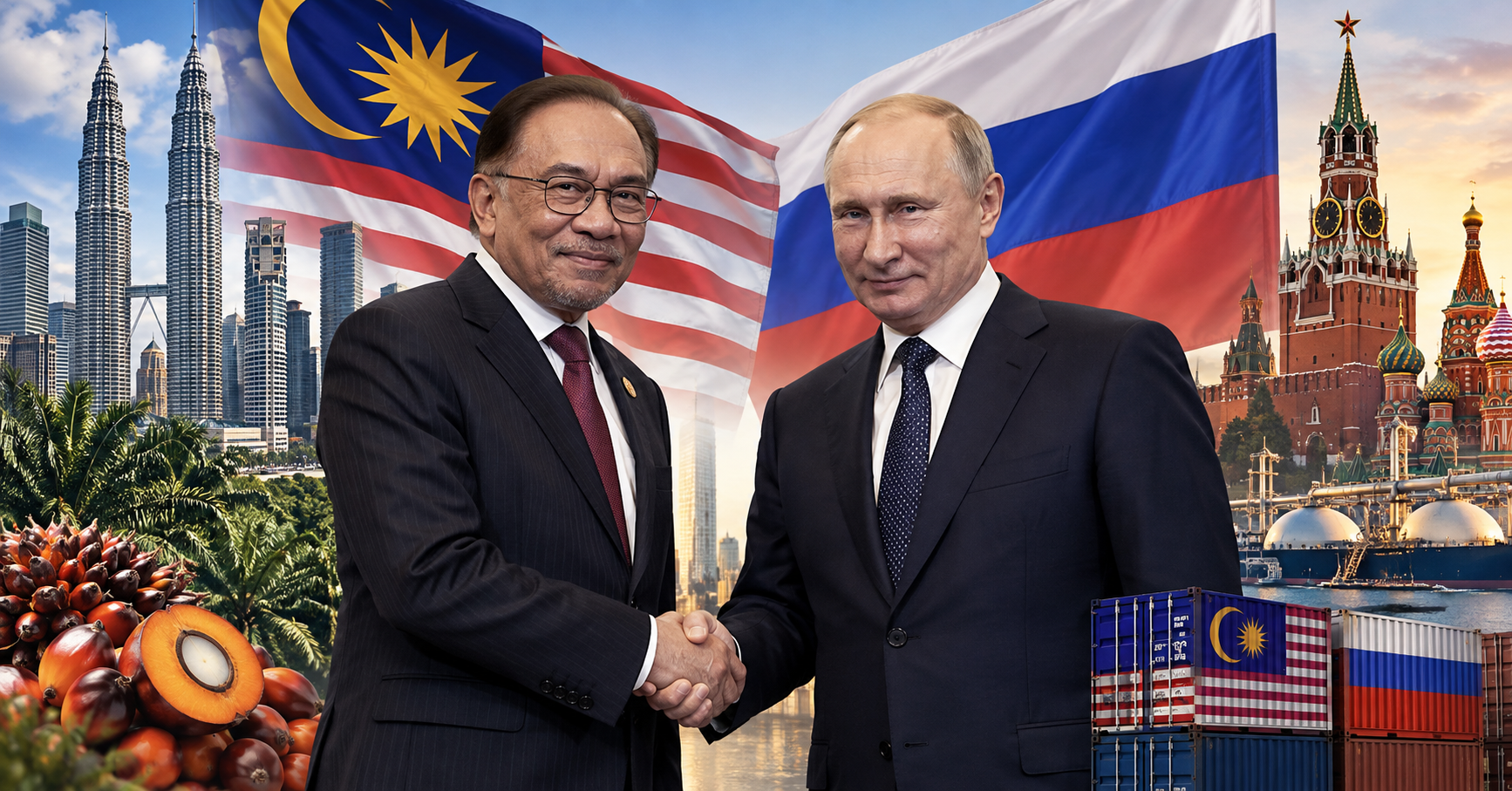
Malaysia’s relationship with Russia appears to be moving beyond diplomatic pleasantries into a more practical phase of economic and strategic cooperation following the latest meeting between Prime Minister Datuk Seri Anwar Ibrahim and Russian President Vladimir Putin.
Meeting on the sidelines of the 18th BRICS Leaders’ Summit in New Delhi, the two leaders agreed on the establishment of a special mechanism between Putrajaya and Moscow aimed at accelerating the implementation of agreements reached between Malaysia and Russia.
On the surface, the announcement may sound administrative. In reality, it could be significant. One of the recurring problems in international diplomacy is that agreements signed or commitments announced during high-level visits can take years to translate into actual trade, investment or projects. A dedicated mechanism to follow through on agreements suggests that both governments want their increasingly warm relationship to produce measurable results.
The meeting also comes at an interesting point in Malaysia’s foreign policy. Malaysia has been a BRICS partner country since January 2025 and has increasingly sought to strengthen relations with emerging economic powers while maintaining its traditional relationships with Western countries, China, Japan, ASEAN and the wider international community.
Palm Oil Could Be an Immediate Winner
One of the most important issues discussed was Russia’s import of Malaysian palm oil.
For Malaysia, finding and expanding markets for palm oil remains strategically important. Russia represents a sizeable market, and stronger agricultural trade could provide another destination for Malaysian commodities at a time when Kuala Lumpur continues to diversify its export markets. Greater Russian purchases would therefore not merely represent another export contract. They could contribute to Malaysia’s wider strategy of reducing dependence on a limited number of major markets.
The economic relationship already has room to grow. Russia was Malaysia’s ninth-largest trading partner among European countries in 2025, with bilateral trade valued at approximately RM8.72 billion, or US$2.04 billion. Malaysian exports included electrical and electronic products, machinery and equipment, parts and processed foods, while imports from Russia included petroleum products, minerals and chemical-related products.
Putin said trade turnover between Malaysia and Russia had grown by 12.9% in the previous year, describing the pace positively.
That growth gives both governments a reason to believe there is considerably more economic potential available.
Direct Flights Could Change the Relationship
Another potentially important development is the push for direct flights between Malaysia and Russia.
Direct connectivity is not merely about tourism. Air links facilitate business travel, investment, education and people-to-people exchanges. When businessmen, students and tourists can travel between two countries without complicated connections through third countries, economic relationships become easier to develop.
The discussions have also included the prospect of visa-free travel for Malaysians. If direct flights and easier visa arrangements eventually materialise, the Malaysia–Russia relationship could become far more visible to ordinary citizens rather than remaining primarily a government-to-government relationship.
Malaysia could benefit from additional Russian tourists, while Russia would become more accessible to Malaysian travellers, students and businesses.
Energy May Be the Bigger Story
Perhaps the most strategically significant component of the relationship is energy.
During the meeting, Anwar expressed appreciation for Russian support for greater energy cooperation with Malaysia. Petronas has already engaged with Russian counterpart Rosneft and other companies regarding possible collaboration in the sector.
Russia remains one of the world’s major energy powers, while Malaysia has decades of expertise through Petronas in oil, gas and increasingly diversified energy operations.
Closer cooperation could therefore extend beyond simply buying and selling petroleum. Depending on the projects eventually negotiated, it could potentially involve technology, upstream and downstream activities, investments and other forms of energy-sector collaboration.
But this is also where Malaysia will have to tread carefully.
Russia remains subject to extensive Western sanctions arising from the war in Ukraine. Malaysia therefore needs to ensure that commercial arrangements involving Russian companies comply with international financial and trading requirements and do not unnecessarily expose Malaysian companies or financial institutions to secondary risks.
Indeed, Malaysia has previously indicated that any potential purchase of Russian oil would have to be acceptable within international trading arrangements.
The challenge for Putrajaya is therefore straightforward: pursue opportunities without allowing those opportunities to create unnecessary economic or diplomatic complications.
Malaysia Is Practising Multi-Alignment
The wider significance of the Anwar–Putin meeting may ultimately have less to do with Russia alone and more to do with how Malaysia sees its position in a changing world.
Malaysia has traditionally avoided placing itself exclusively inside one geopolitical camp.
It maintains deep economic ties with China while enjoying significant security and economic relationships with the United States and other Western economies. It works closely with Japan, South Korea, India, the Middle East and ASEAN while simultaneously expanding its engagement with BRICS countries.
Closer relations with Moscow fit naturally into this approach.
It does not necessarily mean Malaysia is choosing Russia over the West. Nor does participation as a BRICS partner mean Malaysia is abandoning its existing economic relationships. Instead, Malaysia appears to be attempting something more pragmatic: maintaining as many useful relationships as possible. For a medium-sized trading nation, this strategy makes economic sense. Malaysia’s prosperity depends heavily on international trade, investment and access to global markets. Limiting itself to one geopolitical bloc would reduce its options.
But Malaysia Must Know Where the Line Is
There is nevertheless a difference between strategic independence and becoming entangled in the disputes of major powers. Malaysia can trade with Russia without endorsing every Russian policy. In exactly the same way, Malaysia can cooperate with the United States without agreeing with Washington on every international issue, or maintain strong economic relations with China without accepting Beijing’s position on every geopolitical question.
That distinction is important.
Malaysia’s foreign policy works best when relationships are determined by Malaysian interests rather than pressure to choose sides. If Russian cooperation creates markets for Malaysian palm oil, generates investment, increases tourism, strengthens energy security or creates educational opportunities, Malaysia has legitimate reasons to explore those opportunities.
At the same time, Putrajaya must remain conscious of sanctions, financial restrictions, reputational considerations and Malaysia’s relationships with its other major trading partners.
From Handshakes to Results
The most interesting part of the latest Anwar–Putin understanding is therefore not necessarily any single project.
It is the decision to establish a mechanism specifically intended to ensure that agreements actually move forward. Malaysia and Russia have maintained diplomatic relations since 1967, with cooperation covering trade, investment, energy, education, tourism and defence. After almost six decades of diplomatic relations, both sides appear interested in moving towards a more economically substantive partnership.
The next test will be implementation.
Will Russian imports of Malaysian palm oil increase significantly? Will direct Kuala Lumpur–Moscow flights materialise? Will visa-free travel become reality? Will Petronas and Russian energy companies translate discussions into commercially viable projects? And most importantly, will ordinary Malaysians see tangible economic benefits?
Those questions will determine whether the latest meeting becomes another diplomatic headline or the beginning of a genuinely deeper relationship. For Malaysia, however, the broader message is already becoming clear. In an increasingly divided international system, Putrajaya does not appear interested in choosing only Washington, Beijing, Moscow or any other capital. Malaysia is attempting to choose Malaysia.