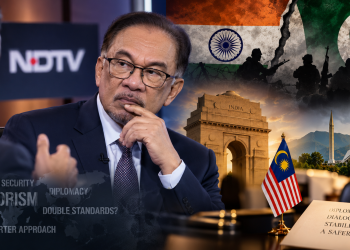


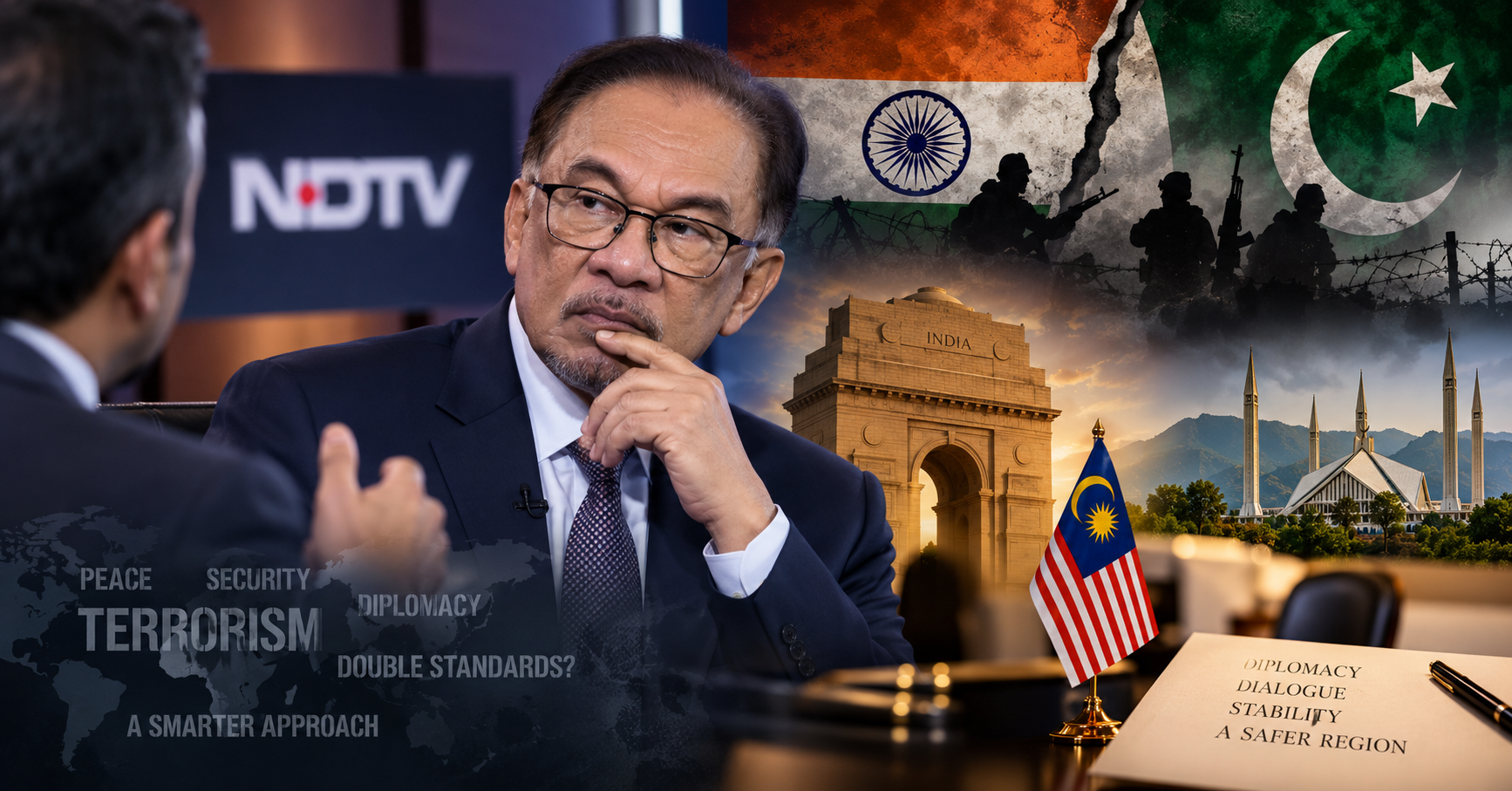
When Prime Minister Anwar Ibrahim sat down with NDTV during his visit to India, he found himself facing one of those questions every international leader should expect when speaking to an Indian news organisation: Pakistan and terrorism.
It was also the kind of question where the substance of the answer mattered almost as much as the wording.
Anwar had spoken forcefully about the conflict in Gaza and described Israel’s actions there as “state-sponsored terrorism”. But when the conversation turned to Pakistan and allegations of terrorism directed against India, his language became considerably more cautious. Reports of the interview said Anwar declined to go as far as applying the same description to Pakistan, referring to the sensitivity of the issue, his friendship with Narendra Modi, Malaysia’s engagement with Pakistan, and the absence of confirmation from Malaysian intelligence that would allow him to make such an attribution.
Diplomatically, one can understand what Anwar was attempting to do. Politically, however, it created an unnecessary problem.
The problem was not that the Malaysian prime minister refused to condemn Pakistan. Malaysia has no obligation to repeat the foreign-policy position of another country. Nor should a Malaysian prime minister casually accuse another sovereign government of sponsoring terrorism without evidence Malaysia itself is prepared to stand behind.
The problem was the contrast.
Once a leader is willing to use an extraordinarily strong expression such as “state-sponsored terrorism” in one international conflict, journalists are inevitably going to ask whether the same moral standard applies elsewhere.
That was the trap.
And Anwar could have escaped it much more elegantly.
Instead of debating whether Pakistan itself should be labelled a terrorist-sponsoring state, he could have moved the conversation towards a universal Malaysian principle: terrorism is terrorism regardless of who commits it, who finances it, where it occurs or which political cause is used to justify it.
In fact, Anwar already had diplomatic ground on which to stand. Earlier in 2026, Malaysia and India issued a joint statement in which Anwar and Modi condemned terrorism in all its forms, called for zero tolerance, and supported cooperation against radicalisation, violent extremism and terrorist financing.
That should have been his shield.
It would have acknowledged India’s pain without automatically endorsing every allegation made by New Delhi. It would have protected Malaysia’s relationship with Pakistan without appearing to defend Islamabad. It would also have preserved Malaysia’s diplomatic independence while denying critics the opportunity to portray Anwar as practising selective outrage.
Most importantly, it would have returned the discussion to principle rather than personalities.
Mentioning that Modi is a close friend does little to answer a question about terrorism. Friendship between leaders is useful diplomacy, but when the question concerns civilians being killed, intelligence assessments and allegations against another state, personal relationships should not be the centre of the answer.
The smarter formulation is simple: India is our friend. Pakistan is our friend. Terrorism is the enemy.