




There is a familiar story in Malaysian business. One generation spends decades building a company from almost nothing, working through difficult years, taking risks and accumulating assets that they hope will provide security for their children. The founder eventually steps aside, the children inherit what was built, and somewhere between the second and third generation, the real test begins. The challenge is no longer simply making money. It is keeping the family, the ownership and the business functioning together.
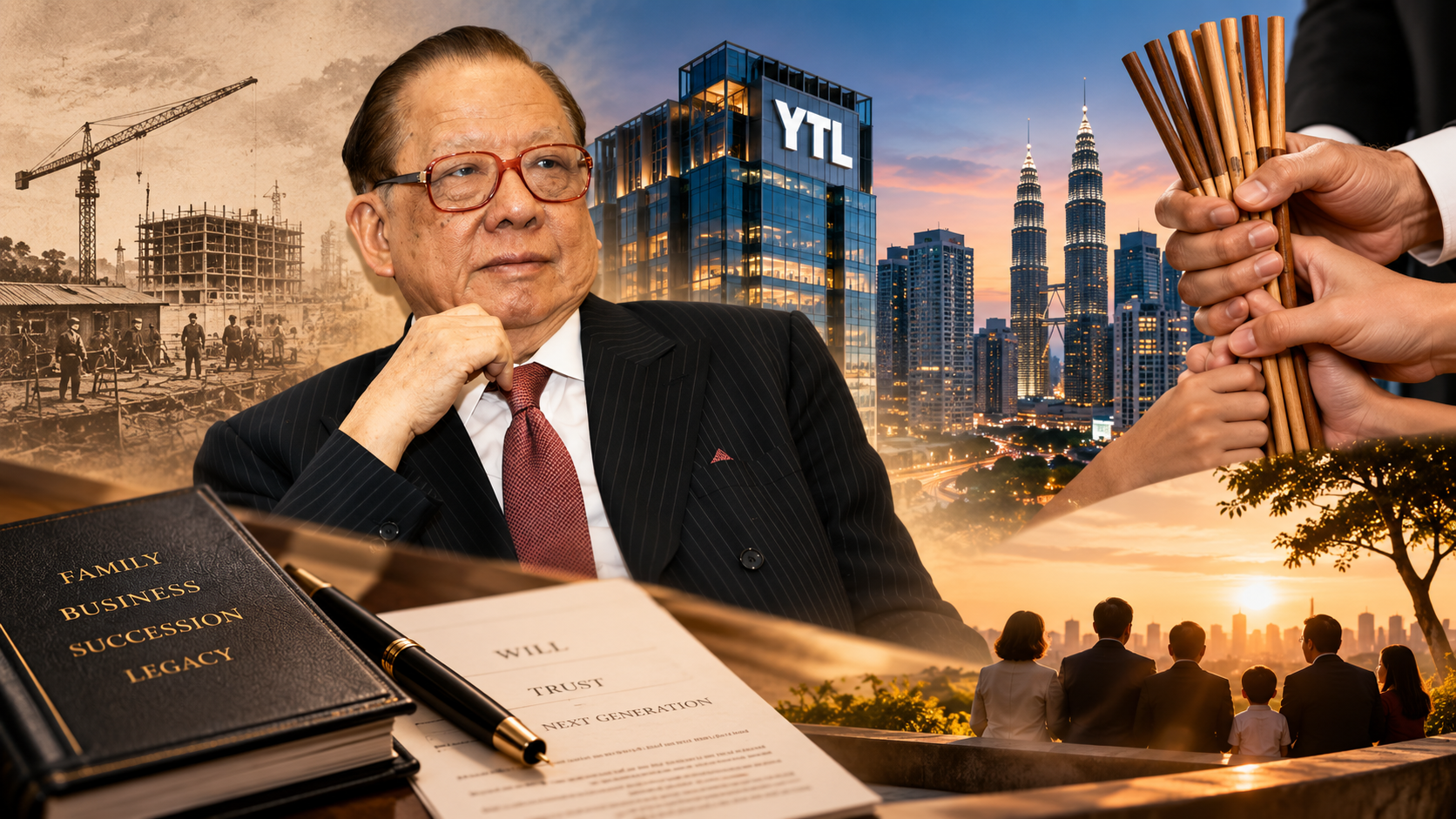
That is what makes the Yeoh family behind YTL Corporation an interesting Malaysian case study. The obvious story is the scale of the business. The more useful story, however, may be how a business founded by one man in 1955 developed into a multinational group while navigating the transition from founder to children and, increasingly, another generation. The late Tan Sri Yeoh Tiong Lay founded what became YTL in 1955. From its beginnings in construction, the group expanded into utilities, cement, property development, hotels, telecommunications and other businesses in Malaysia and abroad. Today, the name YTL is attached to a corporate empire considerably larger than the company its founder started more than seven decades ago.
But corporate growth is only half the story. The Yeoh family also had to confront a problem faced by virtually every successful family business: what happens when one founder becomes an entire family of owners? Yeoh Tiong Lay and his wife, Puan Sri Tan Kai Yong, had seven children. That fact alone makes the family’s development worth examining. Seven children eventually mean seven branches of a family, different personalities, different ambitions, spouses, grandchildren and an increasingly complicated ownership structure. What begins as a simple relationship between a founder and his company can become considerably more difficult with each generation. The Yeoh family’s response appears to have been built around something deceptively simple: structure.
Tan Sri Francis Yeoh serves as executive chairman of YTL Corporation, while his brother Dato’ Yeoh Seok Kian is managing director. Other members of the second generation have taken substantial responsibilities in different areas of the group, including utilities, construction, cement, finance and hospitality. The arrangement illustrates an important principle in family businesses: keeping a family involved does not require everybody to occupy the same position or compete for the same authority. This may sound obvious, but it is where many family businesses begin to struggle.
A founder often runs a company through personality. Everyone knows who makes the final decision because the answer is always the same person. There may be no need for elaborate rules because the founder is effectively the rulebook. He knows the customers, suppliers, bankers and employees. If two managers disagree, they walk into his office and he settles it. The system works until he is no longer there.
The next generation cannot always operate in the same way because authority has been divided among several people. One child may have spent 20 years working in the company, another may have pursued an entirely different career, while a third may own the same number of shares but have little interest in daily operations. If the family has never separated ownership from management, equality from responsibility and inheritance from authority, conflict becomes almost inevitable. This is where the YTL experience becomes more relevant than merely admiring the size of the family’s wealth.
YTL is a family-controlled business, but it is also a listed corporation with formal governance requirements. Its corporate governance framework separates the roles of executive chairman and managing director, includes independent non-executive directors on its board, and identifies succession planning for directors and senior management as part of the board’s responsibilities. In other words, family involvement exists within a corporate structure.
That distinction matters because a family and a company operate according to different principles. A parent may love all seven children equally, but a company cannot necessarily give seven people equal executive authority. Family relationships are built around belonging; businesses have to be built around responsibility, performance and accountability. The same principle applies whether the family owns a multinational corporation or a hardware shop in Ipoh.
One of the most common mistakes in family businesses is assuming that ownership automatically creates management ability. A child may inherit 25% of a company without possessing the experience required to manage 25% of its operations. Conversely, another sibling may have spent decades working inside the business while owning exactly the same stake. Unless these differences are discussed early, resentment develops quietly. The sibling running the company feels that others are enjoying the rewards without carrying the burden. Those outside the company begin wondering whether the sibling in management is treating the business as personal property. Eventually, a disagreement over dividends becomes a disagreement over childhood.
This is why family structuring is not merely a matter for billionaires. It is a practical issue for thousands of Malaysian families who own SMEs, property, agricultural land and other assets. There is also another element in the Yeoh story that cannot be written into an organisation chart: family culture.
YTL’s account of its history places considerable emphasis on the values associated with its founder and his wife, including hard work, honesty, moral responsibility and togetherness. Perhaps the most memorable illustration is the chopstick lesson attributed to Puan Sri Tan Kai Yong. She taught her children and grandchildren that a single chopstick could easily be broken, while a bundle of chopsticks was much harder to break. It is a simple family lesson, but it contains a sophisticated idea about intergenerational wealth. Assets alone cannot hold a family together.
In some cases, wealth does precisely the opposite. The larger the estate, the greater the number of decisions that have to be made about it. Properties must be divided, shares valued, companies controlled and income distributed. What the founder considered one family asset may eventually be viewed by the grandchildren as their individual entitlement. By the third generation, the emotional connection to the original struggle can also weaken. The founder remembers borrowing money, meeting payroll and surviving difficult years. His children probably remember watching him build the company. His grandchildren may simply remember that the company has always existed.
That is a natural progression, but it explains why family values and governance become more important as wealth moves further away from the generation that created it. The Yeoh family’s emphasis on togetherness should therefore not be dismissed as sentimental corporate storytelling. A family that wants to preserve a business over several generations needs some shared understanding of what the family represents, just as the business itself needs rules governing how decisions are made. Neither can replace the other.
Strong family values without proper governance can still produce chaos. Excellent legal structures without any sense of family responsibility can simply make it easier for relatives to conduct their disputes professionally. The objective is to have both.
Succession planning is another part of that equation. Too many families treat succession as something to discuss when the founder becomes seriously ill or, worse, after the funeral. By then, every difficult question arrives at exactly the wrong moment. Who takes control of the company? Should the eldest child lead it? Should the most experienced child lead it? Should professional managers be brought in? Should children who do not work in the business still receive shares? Can family members sell those shares? What happens when ownership eventually passes to grandchildren? None of these questions has a universal answer. The important point is that families should answer them before circumstances answer on their behalf.
YTL’s history now stretches across several generations, with the founder’s children occupying major leadership positions and members of the next generation also becoming involved in the wider group. Its formal corporate governance framework also recognises succession planning as an organisational responsibility rather than something to be improvised when a vacancy suddenly appears. That approach contains a useful lesson for ordinary Malaysian families.
Most families will never need to decide who should control an international conglomerate, but many will eventually face a smaller version of exactly the same problem. The assets may consist of three shoplots, a family restaurant, several acres of plantation land, a transport company, a workshop or simply the house their parents bought decades earlier. The figures may be dramatically different. Human behaviour is not. A RM700,000 house can divide a family just as effectively as a RM700 million company if expectations have never been discussed.
This is why estate and succession planning should not be regarded as something reserved for the extremely wealthy. Parents who have spent a lifetime accumulating assets should also spend time deciding how those assets will eventually be managed. Proper wills matter. Clear ownership matters. Business responsibilities should be documented. Professional legal, accounting and financial advice should be sought where appropriate. Perhaps most importantly, families need conversations. Parents sometimes avoid these discussions because talking about death and inheritance feels uncomfortable. Others assume their children will naturally work everything out because they grew up together.
That is a dangerous assumption.
Children may love one another deeply and still have completely different financial circumstances, spouses, ambitions and attitudes towards inherited property. The brother who desperately needs cash may want to sell an asset that his sister considers part of the family’s history. Neither position necessarily makes either person selfish. They simply want different things from the same inheritance. Good structuring anticipates that difference rather than pretending it will never exist. There is no reason to romanticise the YTL model or assume that every decision made within a large business family can be replicated elsewhere. A publicly listed conglomerate operates under circumstances vastly different from those of a small Malaysian family enterprise. Corporate longevity also does not mean that disagreements never occur behind closed doors.
The useful point is simpler.
YTL Corporation has existed since 1955 and remains substantially associated with the family that founded it. According to the company’s corporate governance disclosure, Yeoh Tiong Lay & Sons Holdings held 48.71% of YTL Corporation as at June 30, 2025. That longevity provides enough history to examine the mechanisms surrounding it: differentiated responsibilities, formal governance, succession planning and an unusually strong emphasis on family cohesion. Perhaps this is where Malaysians can take the most useful lesson from the Yeoh family. We spend enormous amounts of energy building something for the next generation. Parents work overtime, purchase properties, expand businesses and save money because they want their children to start life from a stronger position than they did. But accumulating wealth and preserving wealth are two different skills.
Preserving it requires rules. It requires communication. It requires knowing the difference between being an owner and being a manager. It requires preparing the next generation before they inherit responsibility, rather than simply handing them assets and hoping maturity arrives together with the keys. Above all, it requires recognising that the greatest achievement of a successful family may not be leaving behind the largest possible estate. It may be leaving behind a structure in which the children can inherit that estate without inheriting a war along with it. The late Yeoh Tiong Lay built a business. The larger test for every generation after him is keeping both the business and the family functioning. That is not merely a lesson for YTL. It is a lesson for any Malaysian parent working today to leave something behind tomorrow.