







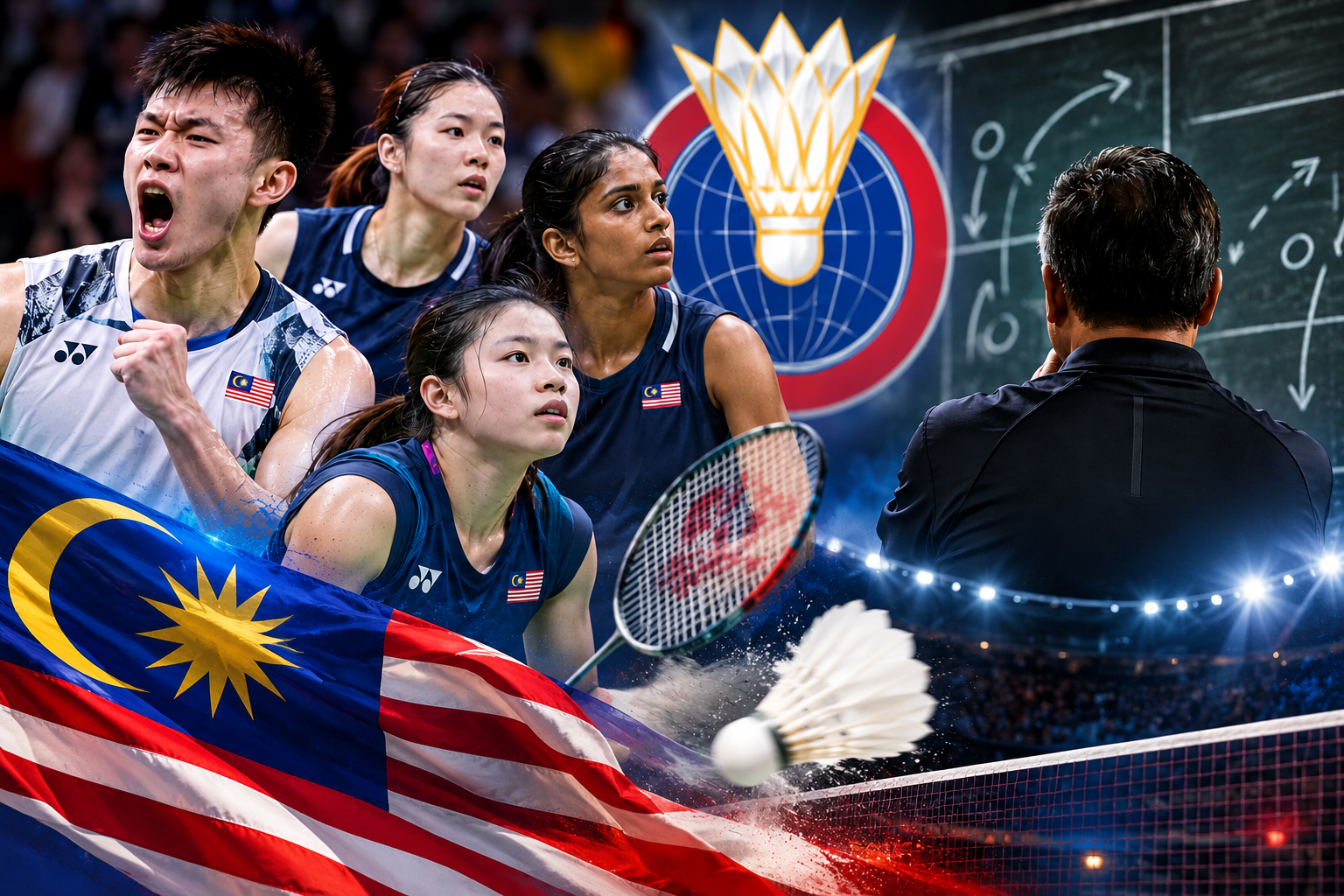
Malaysian badminton does not have a talent problem. It has a bigger question to answer: what exactly are we building towards? That question has become harder to ignore at the Aichi-Nagoya Asian Games.
Malaysia’s men’s team exited in the quarter-finals after a narrow 3-2 defeat to Indonesia. Yet within that defeat came perhaps the clearest reminder of Malaysia’s potential, Leong Jun Hao, ranked far below Jonatan Christie, stunned the world No. 1 in three games. Malaysia’s women also reached the quarter-finals before losing to defending champions South Korea.
So the talent is clearly there. But talent and a successful system are not necessarily the same thing.
Former doubles great Razif Sidek recently questioned BAM’s approach to its Asian Games targets, describing the situation surrounding them as confusing. His criticism touches on a wider concern Malaysian badminton has faced for years: what is the actual benchmark for success? Malaysia has gone 20 years without an Asian Games badminton gold. The last came when Koo Kien Keat and Tan Boon Heong won the men’s doubles title at Doha 2006.
For a country that considers badminton one of its major sports, two decades is a long wait. Nobody expects BAM to manufacture another Lee Chong Wei every five years. China, Indonesia, Japan, South Korea and other badminton powers are formidable opponents, and international badminton is arguably deeper today. But Malaysia should be asking whether we merely want players capable of occasionally beating the world’s best, or a system capable of producing those players consistently.
There is a difference.
BAM deserves some credit
It would be unfair to suggest everything BAM is doing is wrong. There are encouraging signs within the national setup. Younger players are being exposed to major competitions, while BAM’s domestic development structure continues producing prospects. The national Under-18 squad, for example, recently captured four of five titles in the second leg of the BAM National Under-18 Championships. BAM has also increased attention on grassroots development, including plans to double prize money across national-level tournaments from about RM200,000 to RM400,000 annually from next year.
Those investments matter. But development cannot become Malaysian badminton’s permanent answer whenever results fall short. At some point, development must become medals.
Then there are the selections
The Asian Games squad itself produced questions. Lee Zii Jia and Soh Wooi Yik were omitted, while Olympic bronze medallist Aaron Chia was paired with Tee Kai Wun as part of BAM’s longer-term restructuring. BAM has every right to make difficult decisions. Reputation should never guarantee anybody a place in the national team. But major changes also need a clearly understood sporting rationale.
If established partnerships are broken up, what is the objective? If younger combinations are being developed, what is the timeline? Are we rebuilding for Los Angeles 2028? Preparing a generation for Brisbane 2032? Or trying to win immediately? Malaysian badminton supporters do not necessarily need to agree with every decision. They should, however, be able to understand the plan.
Malaysia cannot keep waiting for another superstar
That may ultimately be BAM’s biggest challenge. For years, Malaysian badminton could rely on extraordinary individuals and combinations to carry enormous expectations. When Lee Chong Wei walked onto court, Malaysians expected him to challenge for the title. When our strongest doubles combinations peaked, they could beat anyone. But a national sporting system cannot depend on waiting for exceptional individuals to appear. China does not remain competitive because one superstar survives forever. Indonesia does not stop producing doubles players because one partnership retires. Strong badminton nations build pipelines capable of replacing yesterday’s champions. Malaysia must do the same. There are reasons for optimism. Jun Hao’s victory over Christie showed what is possible. Malaysia still possesses internationally competitive doubles players, while younger talent continues emerging.
The ingredients are there. Now BAM must show how those ingredients fit together. Because Malaysian badminton does not need another restructuring announcement, committee or beautifully presented roadmap. It needs a system where junior development flows naturally into elite competition, coaching decisions have continuity, selections have purpose and promising players become genuine world-beaters. Malaysia can still produce brilliant badminton players. The more important question is whether we can build a system that produces them repeatedly.
A clear plan is what keeps you winning after the talent changes.