





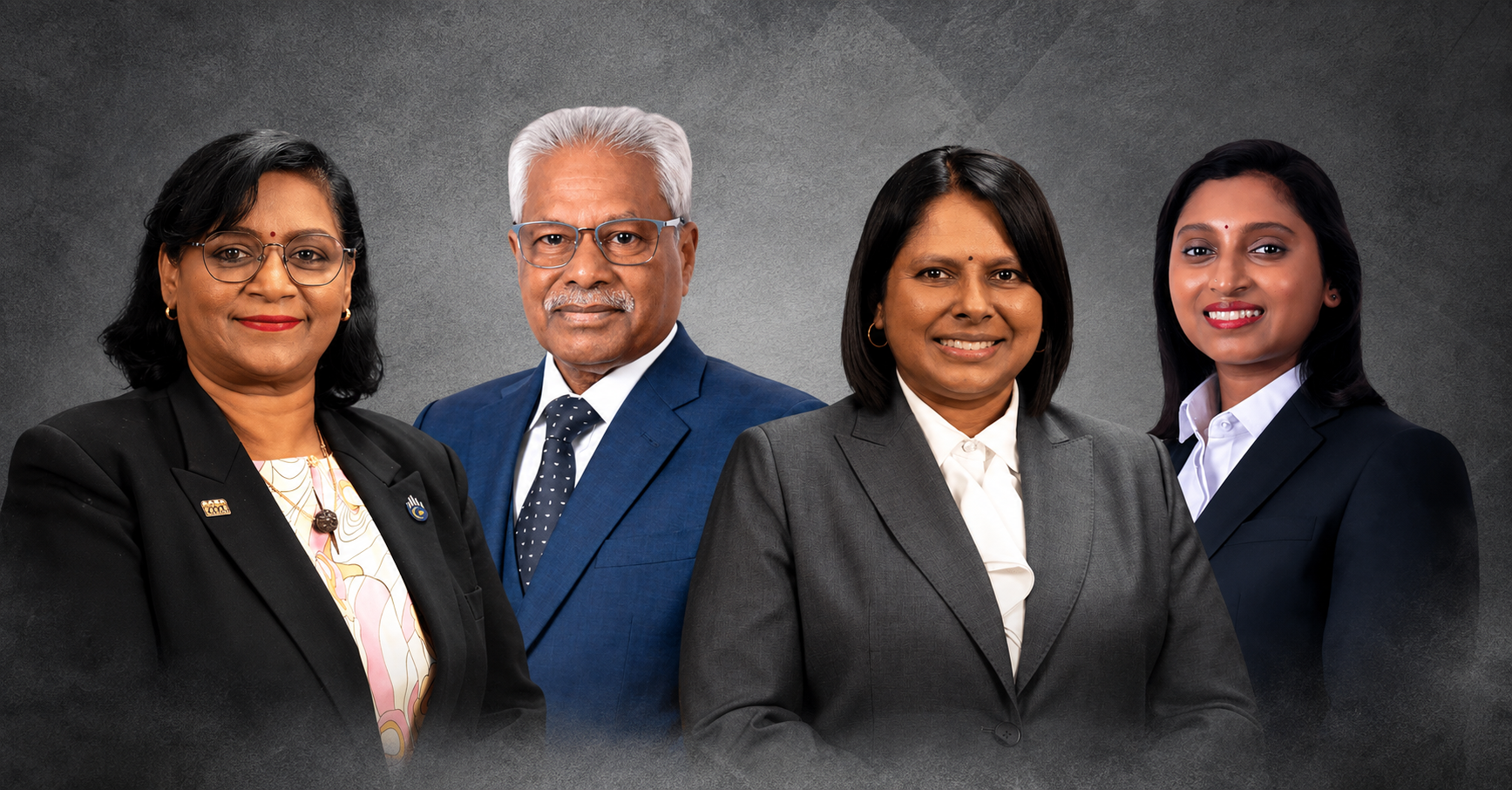
Perak has four Indian state assemblypersons. Ask politically engaged Indians in the state to name all four, however, and the conversation may suddenly become a pop quiz. The four are Thulsi Manogaran of Buntong, V. Bavani of Malim Nawar, Wasanthee Sinnasamy of Hutan Melintang and A. Sivanesan of Sungkai. The official Perak State Legislative Assembly directory confirms all four currently hold their respective seats. But having four representatives on paper and having four representatives who are equally visible to the public are two very different things. That distinction matters.
The Two Who Are Difficult to Miss
A. Sivanesan is perhaps the easiest of the four to identify, partly because he is not merely the Sungkai assemblyman. He is also a Perak executive councillor responsible for Health, Human Resources, National Integration and Indian Community Affairs. That portfolio naturally puts him in the public eye. In April, for example, Sivanesan delivered the state government’s winding-up response covering those portfolios in the Perak assembly. In July, he was publicly speaking about healthcare transformation at the ASEAN and Perak health congresses. He was also at the centre of a public dispute involving hospital contract workers in May, when PSM criticised his handling of the issue and Sivanesan publicly rejected the accusation that he was taking a pro-employer position.
Whether one agrees with Sivanesan on every issue is beside the point. People know he is there. And in politics, being visible enough to be praised, questioned or criticised is part of the job. Thulsi Manogaran in Buntong has also developed a noticeable public presence. Her service centre maintains a public-facing platform for complaints and constituency updates, while Majlis Bandaraya Ipoh documented her participation in several ground visits addressing local problems. In January, she joined city officials and government agencies to inspect problems including stagnant water and recreational facilities. In March, another ground visit focused on recurring flooding affecting Kampung Baru Buntong, Taman Lim and Taman Cherry. Again, this does not automatically mean every problem in Buntong has been solved. No elected representative deserves a gold medal simply for appearing at a drain.
But there is a political lesson here: the voter can see the representative working.
That matters.
Then There Are Bavani and Wasanthee
This is where the argument needs to be fair. It would be inaccurate to say that Malim Nawar ADUN V. Bavani and Hutan Melintang ADUN Wasanthee Sinnasamy have done nothing. There is documented evidence to the contrary. Bavani has been active in the State Assembly and at constituency level. She participated in assembly debates, and her service centre has been involved in community programmes. In May, for example, her office worked with the Kampar District Health Office on a free influenza vaccination programme for senior citizens. Earlier in February, she was involved in a community programme in Tanjung Tualang. Utusan Malaysia also profiled her in January specifically on her approach to constituency service. Wasanthee likewise cannot fairly be described as absent. She has spoken in the State Assembly on issues affecting Hutan Melintang, including flooding and housing, and she sits on a Perak State Assembly select committee reviewing state enactments. She was also publicly present at programmes in the Bagan Datuk and Hilir Perak areas during 2026. So the criticism should not be that these two ADUNs do not work. The more uncomfortable question is this: Why does their work appear to have considerably less public visibility? That is a different problem but in politics, it is still a problem.
Politics Is Not a Secret Government Project
There is an old-fashioned belief among some politicians that good work does not need publicity. It sounds noble. It is also terrible politics. An elected representative does not need to upload a TikTok every time a pothole is patched. Nobody needs a cinematic drone shot of an ADUN handing over a food basket. But representation requires communication. If you raised an issue in the State Assembly, tell the public. If you secured an allocation, explain where it went. If you helped solve a local problem, show what changed. If you disagree with government policy, say so.
And if you represent a minority community that constantly complains about lacking political representation, your responsibility to remain accessible and visible becomes even more important. Otherwise, five years later, the politician appears with a microphone and says, “I have been working quietly.” Unfortunately, elections are not examinations where marks are awarded for showing your rough work after time is up.
Four Seats Should Mean Four Voices
This discussion should also not become a simplistic competition over who is the “best” Indian ADUN. The four represent different constituencies with different demographics and local problems. Sivanesan also enjoys additional statewide visibility because he is an EXCO member, making a direct comparison with an ordinary backbencher imperfect. But there is still a legitimate question of political presence. Indian representation should mean more than counting how many Indian names appear in the State Assembly directory. Representation has to be felt. When estate communities face problems, where are their representatives? When Tamil schools face difficulties, who is raising them? When temples, workers, small traders or lower-income families encounter bureaucratic problems, who is speaking? And when an issue affecting the Indian community becomes controversial, do all four voices emerge or do Malaysians repeatedly hear from the same familiar faces? These are fair questions for voters to ask.
The Real KPI Is Whether People Know What You Did
Thulsi, Bavani, Wasanthee and Sivanesan were elected to represent constituencies, not ethnicities alone. Their Malay, Chinese, Indian and other constituents are equally entitled to their service. But their presence also inevitably carries significance for Perak’s Indian community because there are only four of them. That makes every seat valuable. The evidence shows that all four have performed identifiable public or legislative work. What appears uneven is the visibility, communication and broader public recognition of that work. And perhaps that is where the real criticism belongs. An ADUN does not have to become a social-media celebrity. But an ADUN should not become a political missing-person case either. If four Indian representatives were elected, Perak should be able to hear four voices, see four records of constituency work and judge four performances.