







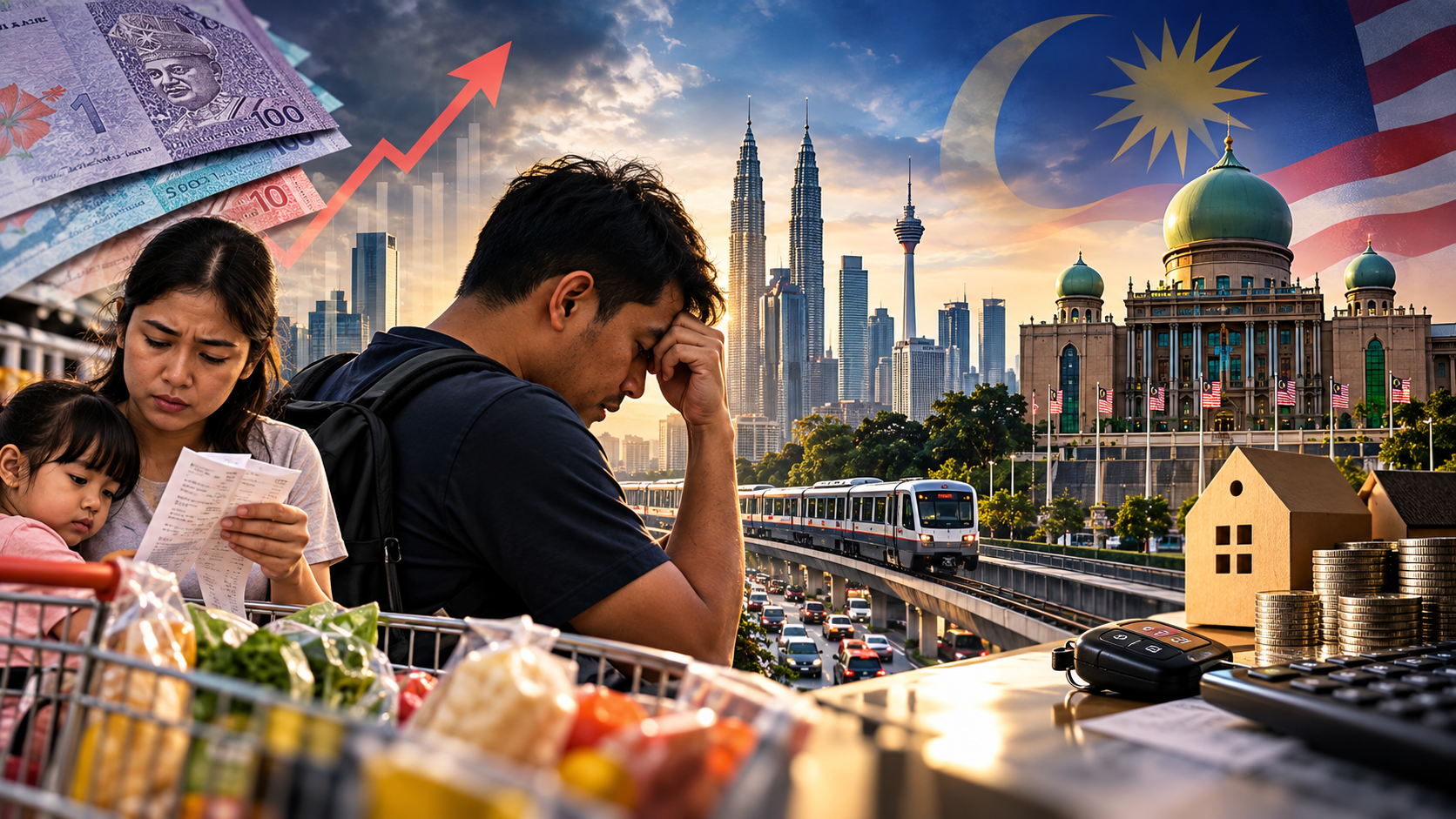
There is an old argument that resurfaces whenever Malaysians complain about the cost of living: the government cannot be expected to put money into everybody’s pocket. On the surface, this is perfectly reasonable. No government can guarantee that every citizen will become wealthy, own a house, drive a new car or retire with enough savings to spend the rest of their days drinking kopi without checking the price. Governments have budgets, economies have limits, and individuals inevitably carry responsibility for the choices they make. Yet this argument also conveniently avoids the more important question, because Malaysians are not necessarily asking the government to provide them with a living. Increasingly, they are asking whether the country they work in still gives them a reasonable chance to earn one.
That distinction matters because Malaysia’s cost-of-living debate has become trapped in an endless conversation about assistance. When household finances become tight, the political response tends to revolve around subsidies, cash transfers, rebates, special assistance and one-off payments. These measures have their place, particularly for households at the bottom of the income ladder, and there is little sense in pretending that RM100 means nothing to a family for whom RM100 can determine what goes into the grocery basket that week. The problem begins when temporary relief slowly becomes the architecture of the economy itself, because there is a fundamental difference between helping someone through difficult circumstances and constructing an economic system in which working people repeatedly need government assistance to afford ordinary life. Malaysia has expanded programmes such as Sumbangan Tunai Rahmah and Sumbangan Asas Rahmah precisely because household pressures are real, while fuel subsidies and other forms of government support continue to absorb significant public resources. These interventions can soften the immediate blow, but they also raise an awkward question that deserves considerably more attention than it receives: should the success of Malaysian economic policy be measured by how much assistance the government is capable of distributing, or by how many Malaysians eventually become financially secure enough that they no longer require it?
This is where statistics and lived experience occasionally appear to be describing two different Malaysia. National economic indicators can improve, household incomes can rise and inflation can moderate, yet many Malaysians can still feel that their money disappears faster than it used to. There is no contradiction in this. Inflation slowing does not mean prices return to where they were several years ago; it merely means that they are increasing more slowly. A household that has already absorbed higher food prices, rent, insurance, transport costs, childcare expenses and loan repayments does not suddenly recover that lost purchasing power because the latest inflation number looks respectable. Economists may therefore be correct when they say inflation is manageable while the person standing at the supermarket checkout is equally correct when wondering why RM100 appears to have developed an impressive ability to disappear. The two experiences can exist simultaneously, which is precisely why governments should be careful about treating macroeconomic statistics as the complete description of household wellbeing. GDP does not buy dinner, national averages do not pay rent, and a percentage point looks considerably less comforting when your car has just broken down three days before payday.
The minimum wage illustrates the same problem. Malaysia’s minimum wage has risen to RM1,700, an important improvement for workers at the lowest end of the wage structure, but a minimum wage should never be confused with a comfortable or even necessarily adequate living wage. The minimum wage answers a legal question about the lowest basic salary an employer may generally pay. The cost of living asks an entirely different question: how much money does a person actually need to function with reasonable dignity in modern Malaysia? The landlord does not offer a discount because somebody earns minimum wage. Neither does the petrol station, supermarket, insurance company, childcare centre or bank. A worker may technically earn above the statutory minimum and still find that after rent, transport, food, utilities and family commitments are deducted, the remaining balance resembles less of a disposable income and more of an accounting error.
This is why endlessly debating whether the minimum wage should increase by another RM100 or RM200 cannot substitute for a serious discussion about wage progression. Malaysia does not merely need higher starting salaries; it needs an economy in which experience, skills, productivity and responsibility translate more consistently into higher earnings over time. A 23-year-old earning a modest salary while beginning a career is one economic reality. A 35-year-old earning only marginally more after a decade of work is a different and much more troubling one. The government itself recognises part of this challenge through policies intended to encourage progressive wages and productivity-linked salary growth. That is important because Malaysia cannot simply legislate itself into prosperity by repeatedly raising minimum wages without considering productivity, competitiveness and the ability of businesses, particularly smaller firms, to absorb higher costs. At the same time, telling workers that wages can only rise when productivity improves becomes equally unsatisfactory if the economy continues producing too many jobs whose business models depend on inexpensive labour.
This brings us back to the original question: what exactly does a government owe its citizens?
It certainly does not owe everybody luxury, guaranteed wealth or protection from every poor financial decision. Citizens have responsibilities of their own. People must work, learn, save where possible, improve their skills and accept that there will always be differences in income and outcomes. Businesses also need sufficient room to invest, make profits, expand and employ people without being regulated into paralysis. An economy in which the government attempts to guarantee every desired outcome would quickly discover that good intentions do not balance national accounts. Yet there are responsibilities that individuals simply cannot perform for themselves. A factory worker cannot redesign the national labour market. A young couple cannot personally reform housing policy. A university graduate cannot build an efficient public transport network between home and work. A hawker cannot determine competition policy, restructure taxation, negotiate trade agreements or decide how billions in public expenditure should be allocated. These are institutional responsibilities, and this is precisely where the role of government becomes unavoidable.
That is also why telling Malaysians to simply work harder whenever they struggle economically is an incomplete answer. Hard work remains essential, but hard work operates inside an economic system whose rules, infrastructure and incentives are heavily influenced by public policy. A person can paddle furiously, but if the boat has a hole in it, motivational speeches about paddling harder eventually become irritating.
Malaysia’s long dependence on subsidies demonstrates the problem particularly well. Subsidies have historically helped keep fuel and other essential costs manageable, but they are expensive and frequently inefficient when people who do not need assistance enjoy the same benefits as households that genuinely do. The movement towards targeted subsidies therefore has a rational economic basis. Public money is finite, and there is little justification for permanently subsidising the consumption of wealthy households simply because the administrative system once found universal subsidies easier to implement. However, subsidy rationalisation creates another responsibility that cannot be ignored. If the government gradually allows Malaysians to face prices that more accurately reflect market realities, then income must become a much larger part of the national economic conversation. Otherwise, Malaysia risks moving from one incomplete model to another: from artificially suppressing prices while wages remain relatively weak to allowing prices to become more realistic while expecting households to somehow absorb the difference.
The long-term objective should not be to make petrol permanently cheap enough that everybody can afford it. It should be to build an economy in which Malaysians earn enough that ordinary fluctuations in petrol prices do not threaten the family budget. The same principle applies to food, housing, transport and other necessities. Subsidies can protect purchasing power temporarily, but they cannot permanently substitute for purchasing power itself.
This is particularly important for the Malaysian middle class, whose frustrations are sometimes difficult to fit neatly into official categories. Many middle-income households are not poor enough to qualify for extensive assistance but are nowhere near wealthy enough to ignore rising costs. They pay mortgages or rent, maintain cars because public transport may not adequately serve their commute, raise children, purchase insurance, support ageing parents and contribute taxes, while discovering that one major repair bill or medical expense can wreck an otherwise carefully managed month. These Malaysians are not necessarily asking Putrajaya to feed them. Many are asking why respectable employment does not provide the degree of economic security that respectable employment was once supposed to provide. That should not automatically be dismissed as entitlement. It should be treated as information about how the economy is functioning.
There is, of course, another danger on the opposite side of the argument. Politics can easily encourage the belief that government possesses an unlimited wallet and that every hardship can be solved with another allocation. It cannot. Every ringgit spent subsidising one thing cannot simultaneously be spent building something else. Excessive subsidies can distort markets, poorly targeted assistance wastes public money, and persistent borrowing merely sends today’s bill to tomorrow’s taxpayer. Malaysia cannot construct a sustainable social contract around the idea that whenever living costs increase, Putrajaya must simply write a bigger cheque.
But neither should the country embrace the equally simplistic idea that as long as GDP grows, citizens should sort themselves out. Economic growth matters because of what it eventually does for people. If the economy expands while large numbers of working households feel permanently insecure, then the problem cannot be waved away by producing another presentation filled with encouraging graphs. A nation is not an Excel spreadsheet, and citizens do not experience economic policy as quarterly percentages. They experience it through whether they can afford a home, whether their salaries improve, whether their children have opportunities, whether they can survive an emergency and whether retirement looks like a stage of life rather than an approaching financial crisis. Perhaps, then, the argument should not be about whether the Malaysian government owes Malaysians a living at all. That formulation creates a false choice between a welfare state that pays for everything and a government that accepts responsibility for almost nothing.
The more sensible social contract lies somewhere between dependency and abandonment.
The government should not guarantee that every Malaysian becomes prosperous, because no government can honestly make such a promise. What it can reasonably be expected to do is construct the conditions in which prosperity remains attainable: an education system that produces useful skills, an economy that creates higher-value employment, wages that have a realistic pathway upwards, housing that does not turn an entire generation into lifelong tenants against their wishes, public transport that reduces the necessity of expensive private vehicles, competitive markets that prevent consumers from being unnecessarily squeezed, and social protection strong enough to catch people when life genuinely goes wrong.
In return, Malaysians cannot outsource every personal responsibility to Putrajaya. Government can create opportunities, but citizens still have to pursue them. It can improve education, but people still have to learn. It can encourage higher wages, but businesses and workers still have to become more productive. It can provide a safety net, but the safety net cannot become the national economic ceiling. The ultimate measure of good economic policy should therefore not be how many Malaysians receive assistance every year, nor how impressive the total value of that assistance sounds when announced at a press conference. A genuinely successful economy should gradually reduce the number of working people who need government intervention merely to maintain an ordinary standard of living. If a Malaysian works full-time, develops useful skills, behaves responsibly and contributes to society, it is reasonable to expect that the economic system should offer some believable route towards greater security. Not instant wealth, not a bungalow in Damansara and certainly not a government-sponsored holiday twice a year, but the basic possibility that ten years of effort will leave that person better off than where he or she started. When that possibility begins to disappear, asking struggling citizens to become more resilient misses the point. Resilience is supposed to help people survive exceptional difficulties; it should not become the permanent economic policy of a country.
So, does the Malaysian government owe Malaysians a living? Not quite.
What it owes Malaysians is arguably more important: a country in which earning a decent living remains realistically possible. And perhaps the best government will ultimately not be the one that proudly announces how many millions of Malaysians depend on its assistance, but the one that can eventually announce that fewer Malaysians need it.