






There is a peculiar rhythm to Malaysian politics. Parties spend months explaining why they cannot possibly work with one another, contest an election as rivals, count the seats and then discover that mathematics has a remarkable ability to cure political incompatibility. That is why the increasingly visible distance between Barisan Nasional and Pakatan Harapan should not automatically be interpreted as the end of their political relationship.
BN is preparing its own platform for GE16. Umno president Ahmad Zahid Hamidi has proposed a broader “Grand Collaboration” based on political understanding rather than party mergers, while BN is developing its own “Blue Malaysia” agenda for the coming general election. At the same time, Zahid insists BN remains committed to the present unity government until the end of the parliamentary term. These positions are not necessarily contradictory.
They reveal something more interesting: BN may increasingly separate the question of whom it fights during GE16 from the question of whom it works with after GE16. And PH may eventually have to make exactly the same distinction.
Johor changed BN’s confidence
To understand BN’s calculations, start with Johor. The July state election produced a result few in Umno could ignore. BN won 48 of the state’s 56 seats, improving on the 40 seats it secured in 2022. PH took the remaining eight, while PN, Bersatu and the other challengers failed to win a seat. One should be careful about extrapolating a state election directly onto a national contest. Johor has its own political history, machinery and personalities.
But politically, the result matters. It gives BN something it badly lacked after GE15: confidence. A party that believes it can recover ground behaves very differently from a party negotiating merely to survive.
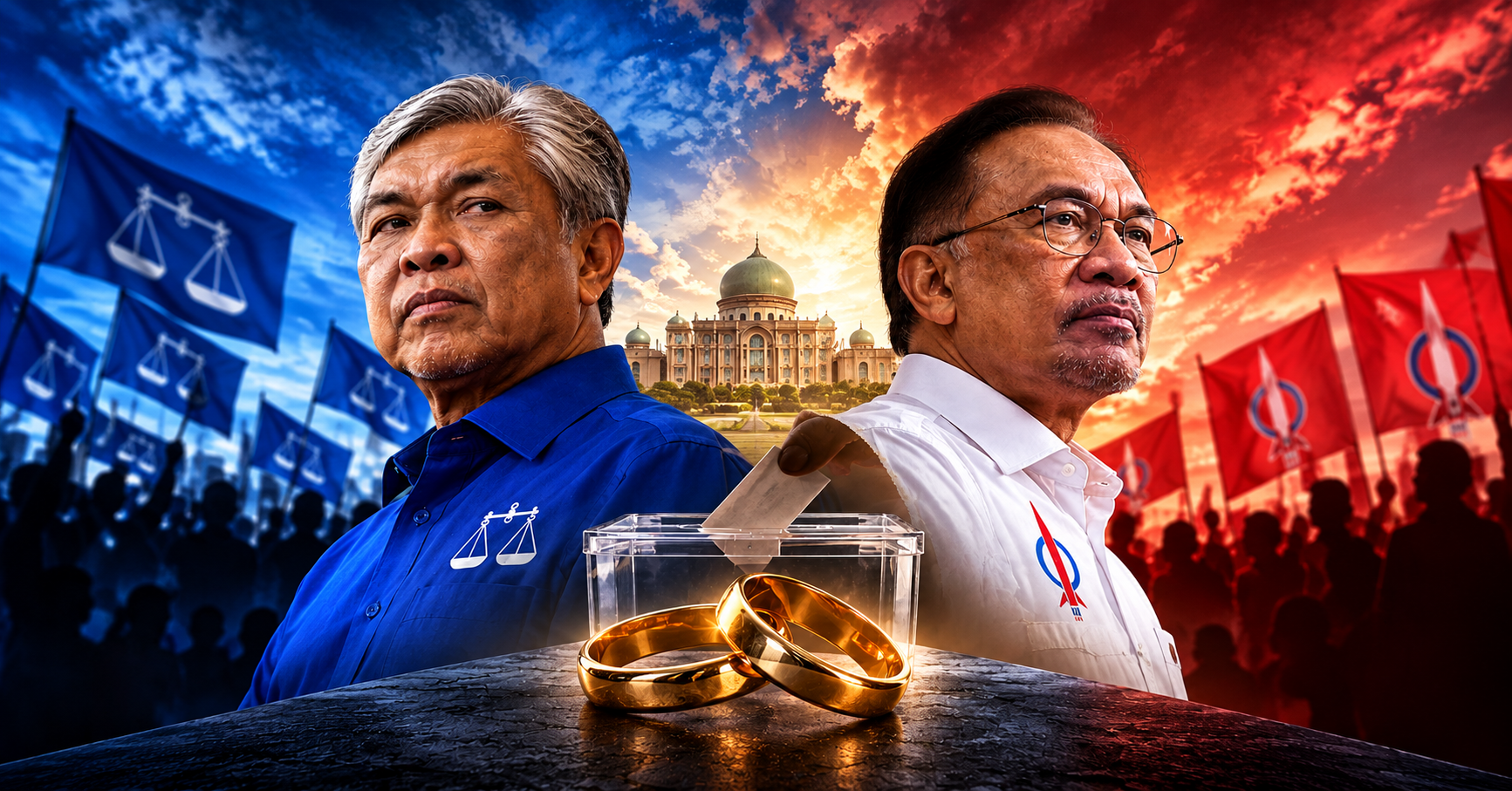
BN therefore has little incentive to enter GE16 presenting itself simply as PH’s permanent junior partner. Umno’s objective is naturally to rebuild its own strength, while MCA and MIC also need constituencies in which they can demonstrate that the BN brand still possesses independent electoral value. In other words, BN may want a divorce before polling day precisely because it wants to know how much political property it still owns. That does not mean it must burn down the matrimonial home.
The real contest is for Malay seats
There is another reason BN may hesitate to bind itself too closely to PH before GE16: the Malay electorate. Umno’s existential problem since 2018 has not simply been PH. It has been fragmentation of the Malay political market. PAS and Bersatu demonstrated that voters who once regarded Umno as the default vehicle of Malay politics had alternatives. For Umno, recovering those voters requires more than ministerial positions in the current government. It requires convincing Malay voters that Umno remains capable of leading rather than merely participating.
That helps explain Zahid’s recent language about broader political understanding and avoiding destructive electoral clashes. His proposed “Grand Collaboration” was explicitly described as an understanding rather than a merger. That distinction matters as a formal coalition is a marriage. An electoral understanding can be closer to agreeing which family gets to use the wedding hall on Saturday and Malaysian politics increasingly appears comfortable with the second arrangement.
Then there is Bersatu
If BN is becoming more confident, Bersatu faces almost the opposite strategic problem. The party once occupied a remarkably advantageous position. It competed for the Malay political centre while sharing an opposition platform with PAS, giving PN a combination of Bersatu’s governmental experience and PAS’s formidable grassroots machinery but the political landscape has become more complicated. Johor demonstrated the scale of the problem. BN won 48 seats; PH won eight. PN and Bersatu won none.
A single state election cannot establish Bersatu’s national strength, particularly across northern and east-coast states where political conditions differ substantially. But it does demonstrate why the party’s alliance choices before GE16 matter enormously. Bersatu’s fundamental question is no longer simply whether it can defeat Umno.
It is where Bersatu fits if Umno successfully rebuilds itself while PAS retains its own substantial Malay base. That produces an extraordinary possibility: Malaysia could enter GE16 with political relationships that would have sounded absurd shortly after GE14. Former enemies may cooperate selectively. Former allies may compete. State-level arrangements may differ from federal ones. Instead of two neat coalitions facing each other, Malaysia may increasingly resemble a political marketplace in which parties negotiate constituency by constituency and renegotiate nationally once the results are known.
Why PH could still need BN
PH has its own dilemma. Its strength remains concentrated differently from BN’s. The two coalitions therefore possess something potentially valuable to one another: electoral reach into constituencies where the other has historically faced limitations. But cooperation carries a cost where PH must maintain the support of voters who spent decades opposing BN. BN must persuade supporters that cooperation with PH has not erased its political identity. This creates an uncomfortable paradox.
Working together before an election can blur both brands while working together after an election can be presented as necessity. GE15 demonstrated the distinction vividly. BN and PH contested against one another, yet the hung Parliament ultimately produced the unity government led by Anwar Ibrahim. The lesson was not that ideological differences disappeared. It was that 112 seats remained 112 seats. Malaysia’s political parties discovered that parliamentary arithmetic is considerably less sentimental than campaign rhetoric.
But wouldn’t voters punish another marriage of convenience?
This is the strongest argument against assuming BN and PH could simply reunite after GE16. Voters are not infinitely tolerant of political flexibility. Another campaign in which BN and PH attack one another fiercely, only to cooperate immediately afterwards, could deepen cynicism among voters who increasingly question what political labels actually mean. Seat negotiations would be painful. Leadership ambitions would collide. Umno grassroots sentiment towards DAP remains complicated, while sections of PH’s electorate remain deeply suspicious of Umno. A BN that performs strongly may demand considerably more influence than it currently exercises while a PH that performs strongly may see little reason to concede it.
And if either side can assemble a government through other partners, the incentive for another BN-PH arrangement diminishes. Those are substantial obstacles. But they do not eliminate the structural argument. Malaysia’s first-past-the-post electoral system can translate relatively small changes in voting patterns into large changes in seats. Sabah and Sarawak add another layer of coalition arithmetic. Multiple Malay-based parties competing for overlapping constituencies further complicate projections. The decisive question after GE16 may therefore not be whether BN and PH like each other. It may be whether either can build a parliamentary majority without the other.
BN’s most valuable asset may be optionality
This is why BN’s current positioning deserves closer attention. Zahid has simultaneously reaffirmed BN’s commitment to the present government and begun articulating BN’s independent ambitions for the next election. Seen superficially, this looks inconsistent but strategically, it can also be understood as preserving options.
BN can finish the parliamentary term with PH. It can enter GE16 under its own banner. It can explore selective understandings designed to minimise damaging multi-cornered contests. And once Malaysians have voted, it can examine the parliamentary numbers. That is not evidence that a post-GE16 BN-PH government will happen. Nobody presently knows what the next Dewan Rakyat will look like, and state-election results should not be treated as national forecasts. But the possibility cannot be dismissed simply because the two coalitions may contest GE16 separately.
Fighting separately may actually make cooperation afterwards politically easier.
Both can tell supporters they defended their identities. Both can measure their genuine electoral strength. Neither needs to surrender large numbers of constituencies through complicated pre-election negotiations. Then, if Parliament is hung, negotiations begin from actual numbers rather than opinion polls and political guesswork.
The election after the election
Malaysia may therefore experience two GE16s. The first will take place in schools, community halls and voting centres across the country. Malaysians will choose their MPs. The second could begin the following morning. That election will take place behind closed doors, through telephone calls, coalition meetings and negotiations over who possesses enough parliamentary support to govern.
BN may talk to PH. PH may talk to BN.
Other coalitions and parties will have their own calculations, while Sabah and Sarawak could again become crucial to any workable majority. None of this means voters are irrelevant. Quite the opposite. Voters determine the bargaining power every party carries into those rooms.
Win 20 seats and you enter negotiations one way. Win 50 and you enter very differently.
That is why the most consequential number on election night may not be which coalition finishes first.
It may simply be whether anyone reaches 112. If somebody does, much of this speculation disappears.
If nobody does, Malaysian politicians will rediscover the virtue of keeping doors unlocked. So BN and PH may well separate before GE16. They may contest against each other, exchange accusations and insist that Malaysia needs a different political direction.
The campaign decides who gets the seats. The seats decide who gets married.