







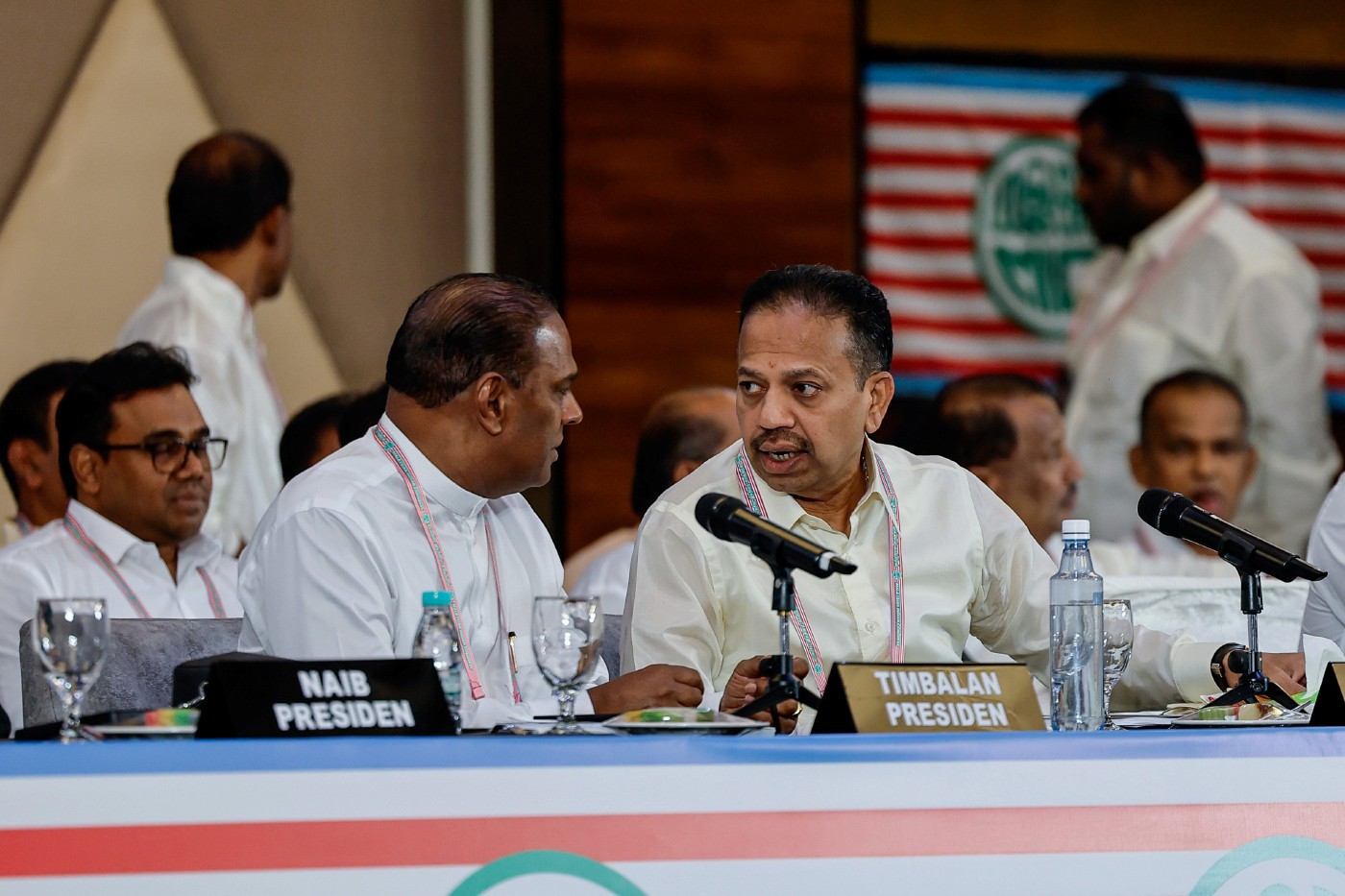
For a party that has survived electoral defeats, shrinking representation and Malaysian Indians becoming increasingly willing to shop around politically, MIC has discovered something surprisingly useful: having a president and deputy president who are not constantly trying to outmanoeuvre each other.
It sounds like a low bar. In MIC politics, it is actually quite an achievement.
The partnership between president Tan Sri S.A. Vigneswaran and deputy president Datuk Seri M. Saravanan may be one of the least discussed reasons MIC continues to remain relevant despite being far smaller electorally than it was during Barisan Nasional’s dominant years.
They are not identical politicians, and that is probably why the combination works.
Vigneswaran comes across as the more institutional and strategic figure. Saravanan is naturally more combative, visible and comfortable taking the fight directly to MIC’s political opponents. One manages the political temperature; the other is perfectly capable of increasing it.
More importantly, their differences have not developed into an open battle for control of MIC. That matters because MIC knows exactly what happens when the president and deputy become competing political centres. The most famous example remains the long rivalry involving former president Tun S. Samy Vellu and his one-time deputy Tan Sri S. Subramaniam. Their political contest was not simply about two personalities. It produced camps, loyalties and years of internal calculations about who stood with whom.
And that is the real danger of a president-deputy war. When the top two fight, eventually everybody underneath has to choose a side. State leaders choose. Division chairmen choose. Youth leaders choose. Branch leaders choose. Even the poor fellow arranging chairs at the annual general meeting may eventually have to decide which photograph should be slightly bigger. A political party then spends enormous energy defeating itself.
MIC can no longer afford that luxury.
This is not the MIC of the era when Barisan Nasional dominated Parliament and MIC could depend on Cabinet representation and traditional seats. Today’s MIC operates in a crowded Indian political marketplace where PKR, DAP and other parties also field Indian leaders and compete directly for the same voters. Every internal fight therefore carries a much higher price. The Vigneswaran-Saravanan arrangement has given MIC something more valuable than it initially appears: stability at the top.
Saravanan can take harder public positions without creating the impression that he is challenging Vigneswaran’s authority. Vigneswaran, meanwhile, does not need to compete with his deputy for every microphone simply to prove who is boss. That division of political roles has helped MIC remain audible even when its electoral numbers suggest it should have become much quieter.
It has also allowed the party to take tougher positions about its relationship with its political partners. MIC has increasingly shown that it is prepared to question whether existing political arrangements actually benefit the party and the Indian community. Whether one agrees with those positions is another matter. The important point is that MIC can have that debate without simultaneously fighting a leadership war internally. Of course, unity between two leaders cannot magically restore MIC.
The party still has a much bigger challenge ahead: convincing Indian voters that MIC offers something they cannot obtain through other multiracial parties. Younger Indians in particular are unlikely to support MIC simply because their parents or grandparents once did. Results will ultimately matter more than speeches, party dinners or photographs of leaders holding hands on stage. But political recovery requires a functioning organisation first.
And this is where Vigneswaran and Saravanan deserve some credit. They appear to understand something previous generations of MIC leaders occasionally forgot: the president and deputy president do not need to love each other, think alike or compete to become the biggest personality in every room.
They simply need to understand that destroying each other means weakening the same party both hope to lead. Perhaps that is why MIC refuses to disappear. Vigneswaran and Saravanan have not returned MIC to its old glory. That would be an exaggerated claim. What they have done is keep the party stable enough to fight another day, loud enough that its political partners cannot completely ignore it, and united enough that the biggest threat to MIC does not come from the office next door.
In Malaysian politics, sometimes survival itself is an achievement.
And for MIC, having Number One and Number Two looking in the same direction instead of looking suspiciously at each other might be the most important change of all.